House Hunting Checklist: What Experienced Buyers Notice Before Making an Offer
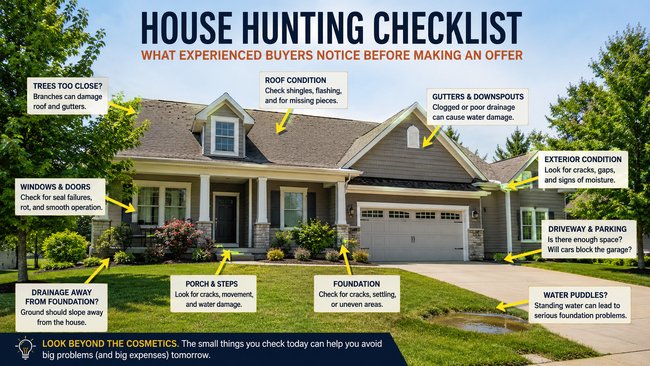
House-hunting? The fact is ‘Buying a house is a lot like getting married—the one you choose is the one you have to live with.’
Most buyers spend their time looking at paint colors, countertops, flooring, and decorating ideas. Unfortunately, those are often the easiest and least expensive things to change. The costly problems are usually hidden beneath the surface.
After more than 35 years in real estate, I’ve learned that buyers who ask the right questions before making an offer are often the happiest homeowners later. This isn’t just another house hunting checklist. It’s a guide to looking at a property the way an experienced buyer would.
First Impressions Matter
Before you walk through the front door, stop and look around.
Ask yourself:
- Is the property well maintained?
- Does the yard drain properly?
- Are there signs of standing water?
- Are trees too close to the roof or foundation?
- Will leaves, pine needles, or tree debris become a constant maintenance issue?
- Is there enough sunlight for a garden if that’s important to you?
Pay attention to the direction of the house as well. Which rooms receive the morning sun? Which rooms will be hot from afternoon sunlight? These details affect everyday living more than many buyers realize. If you’re preparing for a move, our guide to downsizing before a move can help you reduce stress and avoid taking unnecessary items to your new home. Buying a new home often means leaving another behind, and the emotional side of leaving a longtime home is something many buyers underestimate.
Trust Your Nose when House Hunting
One of the first things I notice when entering a house is the smell.
Odors often tell a story.
Look for:
- Musty smells
- Excessive humidity
- Cigarette smoke
- Pet odors
- Sewer odors
- Heavy use of candles or air fresheners
A musty smell may indicate moisture issues. Pet odors and cigarette smoke can be surprisingly difficult and expensive to remove completely.
Don’t Fall in Love With the Cosmetics
A beautiful kitchen can distract buyers from expensive problems.
I’ve watched buyers fall in love with granite countertops while completely missing foundation issues, drainage problems, or signs of water damage.
Whenever you see a recent improvement, ask yourself:
“Was this added for appearance, or was it added to hide a problem?”
Look closely at:
- New flooring
- Fresh paint
- Decorative wall coverings
- Tongue-and-groove ceilings
- Large area rugs
These improvements may be perfectly legitimate. However, they can also hide stains, cracks, uneven floors, or previous damage.
If a rug can be lifted easily, take a look underneath.
Water Is Often the Most Expensive Problem
Water causes more homeowner headaches than almost anything else. Adult children who are helping aging parents downsize often find that a practical house-hunting-checklist makes decision-making much easier.
Check:
- Roof condition
- Curling or damaged shingles
- Sagging roof lines
- Gutters draining against the foundation
- Downspouts that discharge too close to the house
- Water stains on ceilings
- Water stains around doors and windows
- Foundation discoloration
- Crawl space moisture
A fresh coat of paint may hide yesterday’s leak, but it won’t prevent tomorrow’s.
Pay Attention to the Ground
The land is just as important as the house.
Ask:
- Does the ground slope away from the foundation?
- Does water collect near the home?
- Is the property located in a flood zone?
- More importantly, does the road flood?
A house may sit high and dry while the access road becomes impassable during heavy rain.
Look Beyond the House
One of the biggest mistakes buyers make is focusing only on the structure. Features that seem unimportant today may become essential if your goal is to stay in the home for years to come.
Check for:
- Nearby rock quarries
- New subdivision development
- Commercial projects
- Industrial activity
- Future road expansions
Years ago, I saw blasting from a nearby quarry alter underground water movement and create moisture issues where none had existed before.
What surrounds the property matters.
Inspect the Small Things
Small details often reveal larger concerns.
Check:
- Windows for fogging or cracks
- Rotten trim
- Doors that don’t close properly
- Soft flooring around toilets
- Leaks under sinks
- Water pressure
- Appliance condition
- Garage door operation
- Foundation cracks
Quality workmanship usually leaves clues.
So does poor workmanship.
Think About Everyday Living when House Hunting
This section is often overlooked. Many buyers today are interested in choosing property for simple living, which often means looking beyond the house itself and evaluating the surroundings.
Ask yourself:
- Can I easily change the HVAC filter?
- Does it require climbing a ladder?
- Is it located in a crawl space?
- Can I access the attic?
- Can I safely replace light bulbs?
- Where is the electrical panel?
- Where is the water heater?
I once purchased a home where the HVAC filter was located on the unit itself in the crawl space. Every time the filter needed changing, I had to hire someone to crawl under the house and do it.
Not a major defect.
Just a frustration I wish I had noticed before buying.
Find the Main Water Shut-Off Valve
Every homeowner should know where the main water shut-off valve is located.
Not after a pipe bursts.
Not after a water heater fails.
Before an emergency happens.
Ask the seller or agent to show you where it is and make sure it is accessible.
Driveway and Parking Matter More Than You Think

Some floor plans look wonderful until real life begins.
Ask:
- Can visitors park without blocking the garage?
- Can delivery trucks access the property?
- Can you turn around easily?
- Will you be forced to back into traffic?
These may seem like minor inconveniences until they become daily frustrations.
Rural Property Questions
If you’re considering a rural property, add these questions:
- Is there high-speed internet?
- Is cell service reliable?
- Is the home served by public water or a well?
- Are there recorded easements?
- Who maintains shared driveways?
- Is the septic system documented?
Many buyers discover these issues only after moving in.
A Lesson About Well Water Testing
One transaction taught me an important lesson.
A lender required a well water test shortly before closing. The county collected a sample from an outside faucet that had not been used for weeks. The test reported contamination.
Concerned about the results, I hired an independent laboratory.
The technician carefully cleaned the faucet, removed the aerator, sanitized the fixture, flushed the line for several minutes, and then collected the sample.
The independent test showed excellent water quality.
The lesson wasn’t that one test was right and the other was wrong.
The lesson was to understand how the sample was collected and to ask questions if results don’t make sense.
Visit More Than Once
If possible, visit the property:
- During rush hour
- On weekends
- After dark
- During or after a rainstorm
A second visit often reveals things you never noticed the first time.
Frequently Asked Questions About House Hunting
What should I look for when viewing a house?
Look beyond cosmetic features such as paint colors, flooring, and countertops. Pay attention to the roof, drainage, foundation, plumbing, HVAC system, windows, odors, driveway layout, and signs of water damage. A house that looks beautiful can still have expensive problems hiding beneath the surface.
Should I hire a home inspector before buying a house?
Yes. A professional home inspection is one of the best investments a buyer can make. However, knowing what to look for during a showing can help you identify potential concerns before spending money on inspections and due diligence.
What are the biggest red flags when buying a house?
Some of the most common warning signs include:
- Water stains on ceilings or walls
- Foundation cracks
- Poor drainage around the home
- Strong musty odors
- Sagging roof lines
- Fogged windows
- Evidence of previous flooding
- Doors and windows that don’t operate properly
Is it okay to buy a house in a flood zone?
Many homes in flood zones never experience flooding. However, buyers should understand the flood risk, insurance requirements, and whether roads leading to the property can become inaccessible during high water events.
Why should I visit a house more than once?
A second visit often reveals things you missed the first time. Consider visiting during different times of the day, after a rainstorm, or during peak traffic hours to evaluate noise, drainage, sunlight, and neighborhood activity.
How can I tell if a house has water problems?
Look for:
- Water stains
- Musty odors
- Foundation discoloration
- Mold or mildew
- Damp crawl spaces
- Standing water near the foundation
- Gutters draining toward the house
Water problems are among the most expensive issues homeowners face.
What questions should I ask about a rural property?
Ask about:
- Internet service availability
- Cell phone coverage
- Well water
- Septic systems
- Easements
- Road maintenance
- Flood access
- Property boundaries
These issues can affect daily life long after you move in.
How important is driveway layout?
Very important. Buyers often overlook whether they can easily enter and exit the garage when guests, delivery vehicles, or family members are parked in the driveway. What seems like a minor inconvenience during a showing can become a daily frustration.
Can new flooring or fresh paint hide problems?
Sometimes. Cosmetic improvements may simply be updates, but they can also cover stains, uneven floors, cracks, or previous water damage. Buyers should look carefully and ask questions whenever major improvements appear very recent.
What is the most overlooked feature when buying a house?
In my experience, it’s not a feature at all—it’s how the house functions in everyday life. Things like drainage, accessibility, maintenance requirements, parking, storage, sunlight, and the location of HVAC filters or water shut-off valves are often overlooked during a showing but can affect your satisfaction for years.
Bonus FAQ (My Favorite)
This one fits your style perfectly:
What is the biggest mistake home buyers make?
The biggest mistake is falling in love with the house before evaluating the property. Paint colors can be changed. Countertops can be replaced. Problems involving water, drainage, foundations, access, and location are much harder and more expensive to fix.
Final Thoughts
A house can have beautiful countertops and still have expensive problems.
Paint colors can be changed.
Flooring can be replaced.
Water problems, poor drainage, bad access, hidden defects, and inconvenient layouts are much harder to fix.
The goal isn’t to find a perfect house.
The goal is to find a house you can happily live with long after the excitement of moving day has passed. As always, please contact me with questions or comments.
About the Author
Pam Rumley spent more than 35 years helping buyers and sellers navigate the real estate market in Tennessee and Kentucky. As a retired broker and experienced home buyer herself, she understands the details that can impact a property’s long-term value, convenience, and livability. Her articles focus on practical considerations that many buyers overlook during the excitement of house hunting.